Book a call

Four problems that
are probably yours too.

We hit each of these inside our own business first, and built our way out. That is how we know what happens to a tool over time.

Every screen is a recreation with invented client names and sample data, so nothing confidential exists in the file to begin with.

Four examples

01  The spreadsheet nobody can retire

A spreadsheet of 182 standards, turned into a working system

Before
The framework for assessing a client's technology against AppTech's standards lived in a workbook of 38 sheets. Assessing a client meant working through it by hand, and a quarterly review meant rebuilding the pack each time.
Now
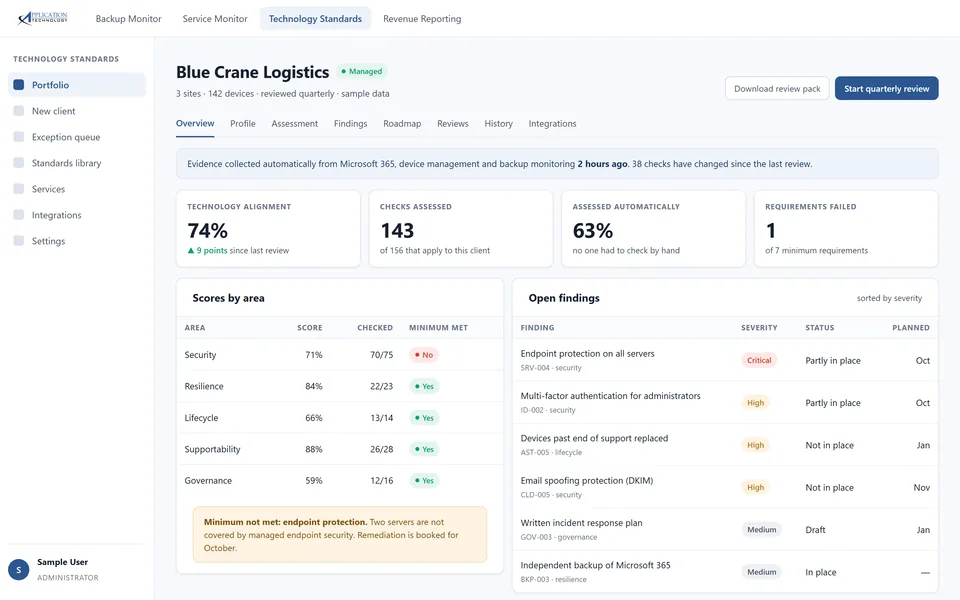
Each client has a profile. The system works out which standards apply, collects evidence automatically from Microsoft 365, device management and backup monitoring, scores what it finds, and keeps the history. Roadmaps, quarterly review packs and prospect scorecards come out of the same data.
Thin glass tiles scattered and overlapping, none of them aligned.
Before
Client technology standards overview: a score for each area, the evidence collected automatically against each standard, and a list of findings still open.
Now Client technology standards: scores, evidence collected automatically, open findings. Sample data.

02  The review nobody has time to do

Every ticket reviewed, every day, without a manager reading them

Before
Knowing whether the team followed process and communicated well meant reading hundreds of tickets a week. Nobody had the time, so nobody did it.
Now
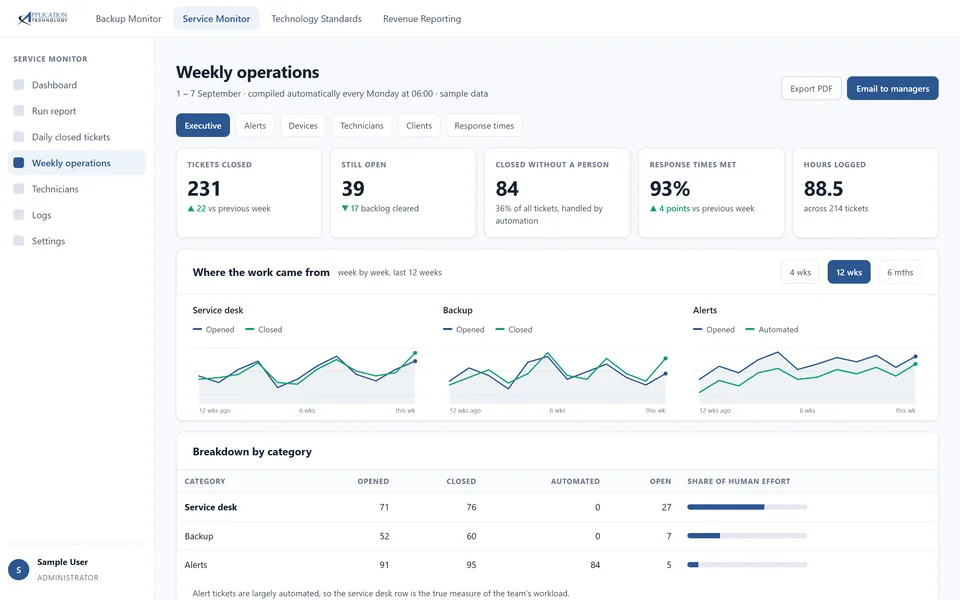
The tool reads every ticket from the service platform, checks it against the company's own rules, uses AI to assess how the client was communicated with, and emails managers a daily report with specific examples. A weekly operations view brings together the service platform and device management.
A heap of hundreds of small glass chips, unsorted.
Before
Weekly operations report: the work the team handled set beside the work automation handled, broken down per client.
Now Weekly operations: what the team handled, what automation handled. Sample data.

03  The failure nobody spotted

Six backup products, hundreds of emails, one screen

Before
Backup results arrived from six different products and hundreds of notification emails. A failure could sit unnoticed among successes.
Now
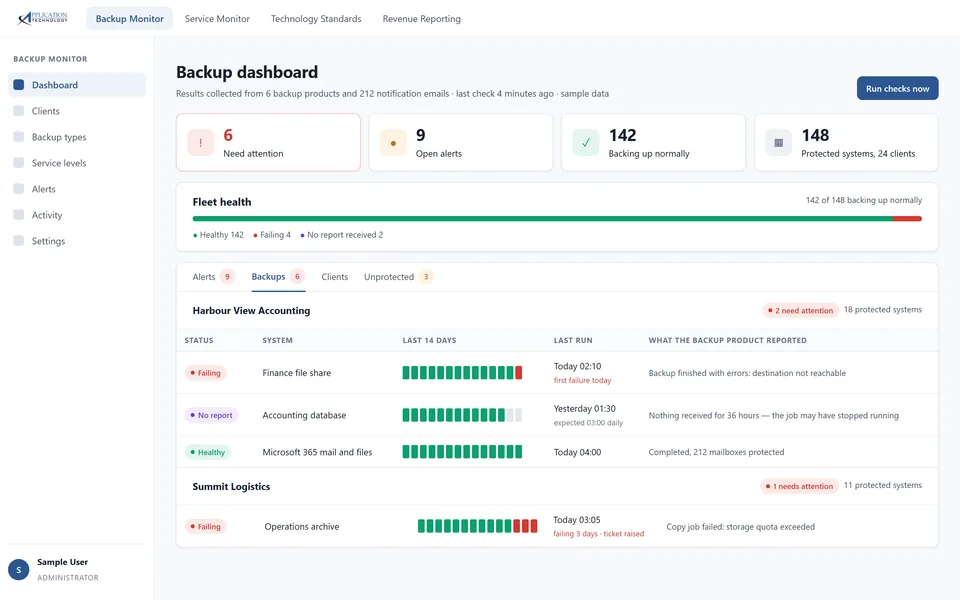
Results are collected from each vendor and from the notification mailbox, checked against each client's service level, and shown as one day-by-day history. Failures raise alerts and, when they persist, create tickets on their own.
Six glowing glass towers standing apart, with nothing connecting them.
Before
Backup monitoring across six products: one day-by-day history per system, with failed days marked and a service level result beside each client.
Now Backup monitoring across six products, one day-by-day view. Sample data.

04  The number nobody could get at

Revenue questions answered without touching the books

Before
Understanding revenue by client and service meant exporting from the accounting system and rebuilding a spreadsheet.
Now
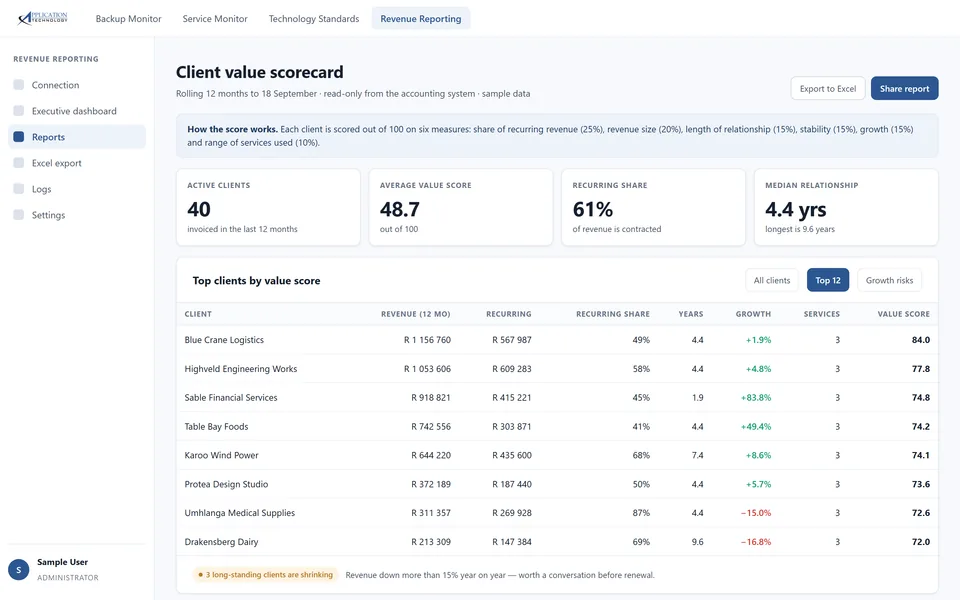
A read-only connection to the accounting system groups and scores revenue, so management can see which clients are growing, which are shrinking and which depend on a single service.
A sealed smoked-glass cube with shapes blurred inside it.
Before
Revenue reporting scorecard: revenue grouped by client and service, with growth and concentration scored for each.
Now Revenue reporting, read-only from the accounting system. Sample data.

Four problems, one shape

Information in several systems

Each one pulls from places that were never meant to talk to each other.

A rule written down once

The standard, the service level, the process. Applied the same way every time.

Nobody has to open it

The result arrives, or the alert arrives. Attention is only spent on exceptions.

A history that builds

Yesterday's answer is still there, so a pattern is visible before it is a problem.

Tell us about the process that wastes the most time

One call is usually enough to know whether it is worth building, and how we would approach it.

  • We read your enquiry and reply within one working day.
  • If an off-the-shelf product would do the job better, we will say so.
  • No sales sequence and no automated follow-ups.